

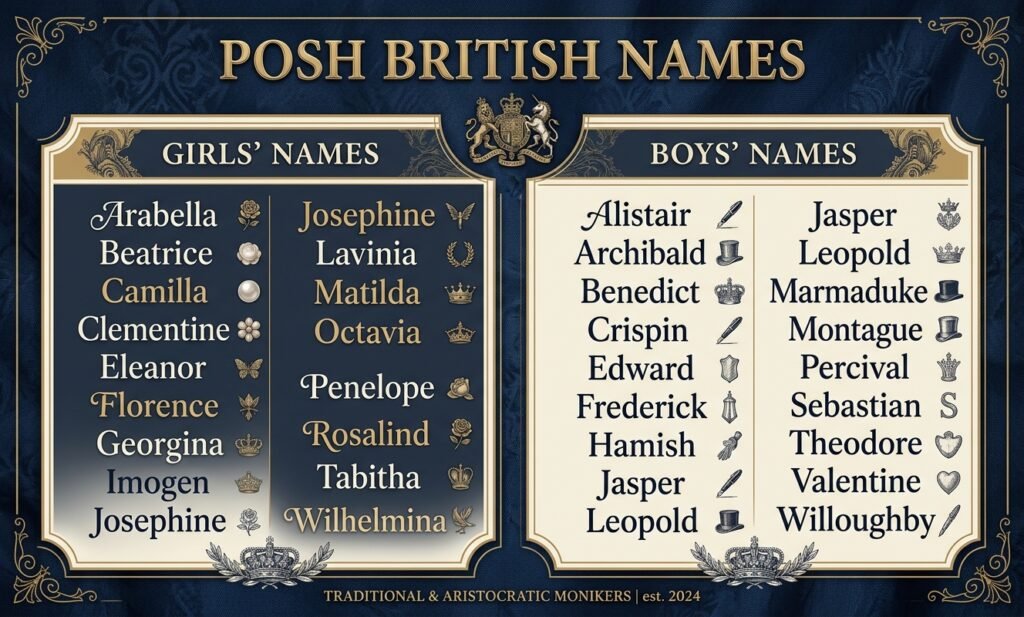
There’s something unmistakable about a name that sounds “posh.” Say “Tarquin” or “Arabella” out loud, and an entire world appears in your mind—manor houses with sweeping lawns, silver tea sets, Labradors sprawled by the fire, and a voice trained at an elite boarding school. British posh names carry centuries of history, class signaling, and cultural weight packed into just a syllable or two. This article explores where these names come from, what makes them “posh” in the first place, and gives you an extensive list across categories so you can find (or simply admire) the perfect aristocratic-sounding name.
What Actually Makes a Name “Posh”?
Before diving into lists, it’s worth understanding the sociology behind posh names. In Britain, name choice has long been tangled up with class. The upper classes—aristocrats, landed gentry, and old-money families—have historically favored certain naming patterns that differ sharply from working-class or even middle-class conventions.
A few defining features tend to appear again and again:
Historical and dynastic roots. Many posh names trace back through generations of the same family, often repeating a small pool of names tied to inheritance, godparents, or royal connections. Names like Edmund, Cordelia, or Peregrine have been passed down for centuries in certain families, becoming almost a badge of lineage.
French and Latin influence. After the Norman Conquest, French names entered the English aristocracy and never really left. Names like Beatrice, Aurelia, and Sebastian carry that Continental, slightly formal flavor that reads as elevated rather than everyday.
Unusual or “outdated” charm. Posh names often sound deliberately old-fashioned—names your working-class Victorian ancestors might have found too grand, or that dropped out of common use decades ago and were preserved only in wealthier circles. Think Hugo, Cressida, or Rupert.
Surnames used as first names. This is one of the clearest class markers in British naming culture. Using a family surname (often the mother’s maiden name or an ancestral estate name) as a child’s first name signals inherited status. Examples include Fitzgerald, Sinclair, Alistair, and Percy.
Diminutive-resistant formality. Posh names often can’t easily be shortened into a casual nickname, or if they can, the nickname itself sounds equally elevated (Bertie for Herbert, Bunty for various names, Tuppy, Piglet-style pet names used ironically among the upper classes).
Association with public schools and Oxbridge. Certain names have become shorthand for a particular type of British social identity—privately educated, often politically or economically influential, sometimes satirized in shows like Made in Chelsea or novels by Evelyn Waugh and Nancy Mitford.
Posh British Names for Boys
Tarquin — Possibly the quintessential “posh boy” name in British popular culture, often used almost comically to signal extreme privilege. Rooted in Roman history (the Tarquin kings of early Rome), it’s rare enough that anyone bearing it stands out immediately.
Rupert — A name with genuine royal pedigree (Prince Rupert of the Rhine), Rupert has long been associated with charming, sometimes bumbling upper-class characters in British fiction and film.
Hugo — Elegant, European, and popular among the British upper-middle and upper classes for decades. It has crossover appeal, sounding sophisticated without being overly obscure.
Sebastian — Carries literary weight thanks to Evelyn Waugh’s Brideshead Revisited, where Sebastian Flyte embodies aristocratic decadence, wit, and tragedy.
Peregrine — Meaning “traveler” or “pilgrim,” this name is strongly associated with old aristocratic families and often shortened to “Perry.”
Alistair/Alastair — A Scottish variant of Alexander, favored by well-to-do families, particularly those with Scottish estates or clan connections.
Cosmo — Short, distinctive, and slightly eccentric in the way that only genuinely wealthy families can pull off without irony.
Barnaby — A more approachable posh name, often used in period dramas to signal a country-gentleman sensibility.
Fitzwilliam — Famously the first name of Mr. Darcy in Pride and Prejudice, this compound surname-name screams landed gentry.
Crispin — Uncommon and formal, evoking Shakespeare’s St. Crispin’s Day speech and a certain literary grandeur.
Piers — Short, sharp, and historically tied to medieval nobility (Piers Gaveston, favorite of Edward II).
Casper/Jasper — Jasper especially has a slightly bohemian-aristocratic feel, popular in artistic upper-class circles.
Rafferty — An Irish-influenced name that’s become fashionable among wealthier British families in the last few decades.
Monty — Short for Montgomery, evoking both military history (Field Marshal Montgomery) and boarding-school charm.
Inigo — Rare and striking, associated with the great architect Inigo Jones, and carrying strong artistic-aristocratic connotations.
Posh British Names for Girls
Arabella — Elegant, flowing, and instantly recognizable as upper-class, Arabella has been used by British nobility for centuries.
Cordelia — Shakespearean gravitas meets aristocratic softness; King Lear’s youngest daughter shares her name with countless well-bred English girls.
Cressida — Another literary name (from Chaucer and Shakespeare’s Troilus and Cressida), delicate yet distinctive.
Ottoline — Strongly associated with Lady Ottoline Morrell, the bohemian aristocratic hostess who supported the Bloomsbury Group.
Rosamund — Meaning “rose of the world” or “horse protector,” this name has been used by English nobility since medieval times.
Araminta — Quirky, old-fashioned, and unmistakably posh, often shortened affectionately to “Minty.”
Clementine — Popularized partly through Winston Churchill’s wife, Clementine Churchill, this name balances warmth with unmistakable pedigree.
Beatrice — A genuinely royal name (Princess Beatrice), Latin in origin, meaning “she who brings happiness.”
Persephone — Greek mythology filtered through British upper-class taste for the classical and the dramatic.
Tabitha — Slightly whimsical, associated with country houses and horses, popular among the county set.
Camilla — Forever tied to Queen Camilla, this name carries genuine royal and aristocratic association.
Georgiana — Made famous by Georgiana, Duchess of Devonshire, one of the most glamorous aristocrats of the 18th century.
Honor/Honoria — A virtue name favored by old Catholic aristocratic families in Britain and Ireland.
Flora — Simple yet distinctly upper-class, especially in Scottish aristocratic families.
Portia — Another Shakespearean borrowing (The Merchant of Venice), sharp and sophisticated.
Verity — A virtue name with a crisp, confident sound favored by well-heeled English families.
Posh Surnames Used as First Names
One of the clearest signals of British upper-class naming is repurposing family surnames as given names—often to preserve a maternal family name or honor an ancestral estate.
- Sinclair
- Fitzgerald
- Percy
- Sterling
- Alderton
- Waverley
- Beaumont
- Cavendish
- Grosvenor
- Spencer
- Winston
- Hartley
- Ashworth
- Vane
- Chetwynd
These names often appear as middle names even when not used as first names, preserving family lineage across generations without necessarily branding a child with an unusual first name.
Posh Nicknames and Pet Names
Interestingly, the British upper classes have their own tradition of nicknames that sound almost comically endearing yet remain firmly associated with privilege:
- Bunny (often for Bernard or as a general pet name)
- Bertie (for Herbert, Albert, or Robert—famously used by the future King George VI, “Bertie”)
- Pips or Pippa (for Philippa)
- Bibi
- Dosh or Dodo
- Fruity
- Squiffy
- Boofy
These nicknames often appear in memoirs of British aristocracy, particularly from the interwar period, and were popularized in works like Nancy Mitford’s novels, which satirized (while also documenting) upper-class British naming quirks.
The Royal Influence
It’s impossible to discuss posh British names without acknowledging the influence of the Royal Family. Royal names tend to trickle down into wider aristocratic and upper-middle-class use, partly through admiration and partly through genuine family connections (many aristocratic families are related to or connected with the royals through centuries of intermarriage).
Names like Charlotte, George, Louis, Archie, Lilibet, Eugenie, and Beatrice have all seen upticks in usage following royal births. Even older royal names—Victoria, Albert, Edward, Alexandra—retain a permanent posh sheen simply through their historical association with the crown.
Posh Names in Pop Culture
British television and film have both celebrated and gently mocked posh naming conventions. Shows like Downton Abbey gave audiences names like Mary, Edith, Sybil, Matthew, and Robert, all deliberately chosen to sound authentically aristocratic for the Edwardian era. Meanwhile, more contemporary shows like Made in Chelsea feature real people with names like Binky, Ollie, Cheska, and Spencer, showing how posh naming conventions persist into the modern day, often blending old aristocratic patterns with newer, media-friendly nicknames.
Even satire relies on posh names for comedic effect—characters named Tarquin, Jocasta, or Rupert are shorthand in British comedy for a certain type of out-of-touch privilege, showing just how deeply embedded these names are in the national psyche as class markers.
Choosing a Posh Name Today
If you’re drawn to these names—whether for a baby, a character in a novel, or simply out of fascination with British culture—here are a few tips:
- Consider pairing with a simpler surname. An elaborate first name like Persephone or Tarquin often works best balanced against a shorter, plainer surname.
- Think about nicknames. Many posh names naturally shorten into charming diminutives (Arabella to Bella, Peregrine to Perry), which can soften an otherwise grand name for everyday use.
- Look to literature and history, not just royalty. Some of the richest posh names come from classic British novels, Shakespeare, and historical aristocratic families rather than the current Royal Family alone.
- Middle names offer flexibility. If a name like Fitzwilliam or Ottoline feels too bold as a first name, it can work beautifully as a middle name, preserving family heritage without the daily commitment.
Final Thoughts
Posh British names are more than just labels—they’re compact stories about class, history, literature, and identity. Whether rooted in Norman French, Latin classicism, Shakespearean drama, or genuine aristocratic bloodlines, these names carry a certain theatrical elegance that continues to fascinate people well beyond Britain’s borders. Whether you’re naming a child, a character, or just indulging a love of Britishness, there’s a rich, centuries-deep well of options to draw from—each one carrying just a little bit of manor-house grandeur.
