

Few names carry a fragrance. Jasmine does. Say it aloud, and you can almost smell the white blossoms that open at dusk. But beyond its sweet sound, parents and name lovers keep asking the same practical question: is Jasmine a girl’s name or a boy’s name?
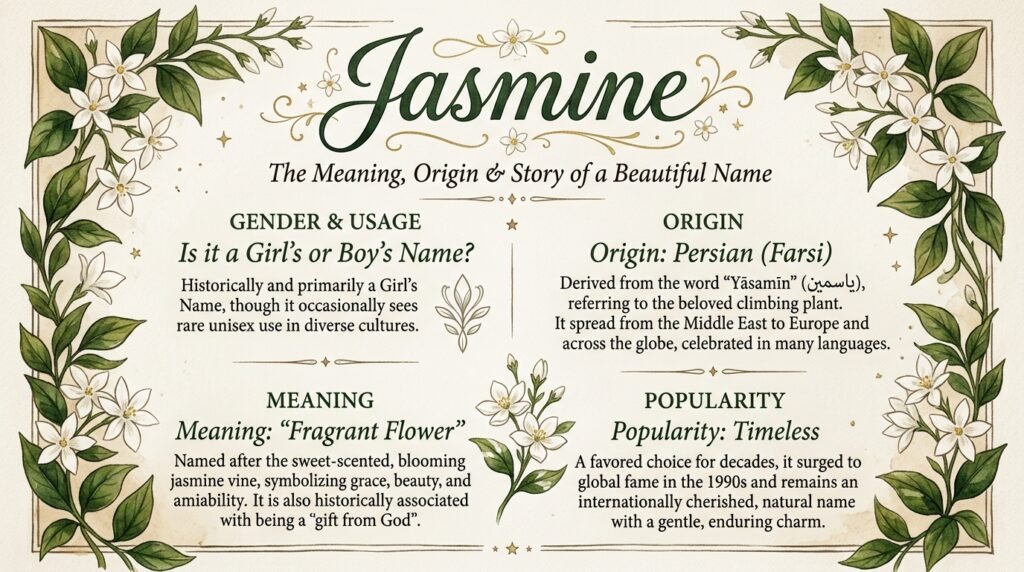
The short answer: Jasmine is overwhelmingly a girl’s name. The longer answer, covering where it comes from, what it truly means, how popular it has been, and whether it ever works for boys, is far more interesting. Let’s go through it properly.
Is Jasmine a Girl’s Name or a Boy’s Name?
Jasmine is a feminine name in virtually every culture where it is used. In the United States, official baby-name records from the Social Security Administration show Jasmine given almost exclusively to girls. Boys named Jasmine are statistically very rare.
Why is it so strongly feminine? Three reasons:
- Flower names are traditionally feminine. Rose, Lily, Iris, Daisy, and Violet follow the same pattern. If you enjoy this naming style, see our guide to beautiful flower names with meanings.
- The “-ine” ending (Jasmine, Caroline, Josephine) reads as feminine in English.
- Pop culture cemented it. Disney’s Princess Jasmine made the name a girl’s name for a whole generation.
Can Jasmine Ever Be a Boy’s Name?
Rarely, and mostly through variations. In some Arabic-speaking and South Asian communities, spellings such as Yasmin appear in very limited male use, and a few families choose flower names for boys to be deliberately different. But if you search any major name database, you will find Jasmine, in all its spellings, firmly in the girls’ column. For a boy, a gender-neutral nature name is usually a better match, and our list of unique names for boys and girls has plenty of ideas.
Jasmine Name Meaning
The meaning of Jasmine is simple and lovely: “jasmine flower.”
Jasmine belongs to the olive family (genus Jasminum), a group of fragrant climbing shrubs. The flowers are most often white, though some varieties are yellow, and they are famous for their strong, sweet scent, especially at night.
You will often see the claim that Jasmine means “gift from God.” That is a popular modern interpretation, but it is not the original etymology. The name’s true root meaning is the flower itself. Still, many parents like the “gift” idea because a newborn feels exactly like one, and there is nothing wrong with giving a name personal meaning.
Symbolically, jasmine stands for:
- Purity and innocence, because of its white blossoms
- Love and sensuality, because of its intoxicating perfume
- Grace and elegance, a recurring theme in poetry from Persia to India
- Hope and renewal, since it blooms even in warm, difficult climates
Jasmine Name Origin
Jasmine’s journey across languages reads like a travel diary:
- Persian: The name starts with yasmin (یاسمین), the Persian word for the flower.
- Arabic: It passed into Arabic as yasmīn, where it is still a beloved girl’s name.
- Medieval Latin and French: European traders carried the plant and the word west, and it became jasminum in Latin and jasmin in French.
- English: By the 16th century, the flower had a place in English gardens. As a given name, though, Jasmine only became common in the 20th century.
For a deeper etymological summary, Behind the Name is a trustworthy reference, and the plant itself is well documented in this overview of the jasmine genus.
A Note for South Asian Readers
Jasmine is deeply rooted in this region’s culture. The jasmine plant (Jasminum officinale) is the national flower of Pakistan, where it is known by names like Chambeli and Yasmeen. Garlands of mogra and chambeli appear at weddings, festivals, and on bedside tables across the subcontinent. So when a family here chooses Yasmeen or Jasmine for a daughter, they are choosing something both global and local.
Jasmine Name Popularity
Jasmine’s popularity story has a clear shape: a quiet start, a big surge, and a graceful settling.
- Before the 1970s: Jasmine was uncommon in English-speaking countries.
- 1980s: Steady climb as flower names grew fashionable.
- Early to mid-1990s: A major peak. Disney’s Aladdin (1992) introduced Princess Jasmine, and the name climbed high in US rankings, landing within the top 50 for several years.
- 2000s onward: Gradual decline from the peak, though it remained a familiar, well-liked choice.
- Today: Jasmine is no longer trending, but it is far from dated. It feels classic-floral rather than fashionable-new, which many parents actually prefer.
Because the name’s peak was in the 1990s, many women named Jasmine are now in their 20s and 30s. That gives the name a “grown-up” feel. For real, current ranking numbers, check the official SSA baby names database, which lets you search any name by year.
Jasmine Spelling Variations Around the World
| Variation | Language / Region | Notes |
|---|---|---|
| Jasmine | English | The most common spelling |
| Jasmin | German, French | Shorter, more minimal |
| Yasmin / Yasmeen | Arabic, Urdu, Persian | Closest to the original sound |
| Yasemin | Turkish | Popular in Turkey |
| Jazmín | Spanish | Common across Latin America |
| Gelsomina | Italian | Famous from Fellini’s film La Strada |
| Jessamine | Old English | Vintage, literary feel |
| Yasmina | Spanish, Arabic | Longer, melodic form |
| Jazmyn / Jasmyn | Modern English | Creative spellings |
Nicknames for Jasmine
Jasmine takes well to short forms:
- Jaz and Jazzy, energetic and modern
- Jas and Jassie, soft and friendly
- Min and Minnie, playful
- Yaz, for Yasmin and Yasmeen versions
Famous People Named Jasmine
Having well-known bearers helps a name feel real. A few examples:
- Princess Jasmine, the Disney heroine from Aladdin
- Jasmine Sullivan, Grammy-winning R&B singer
- Jasmine Guy, actress, known for A Different World
- Jasmine Tookes, model
- Jasmine Paolini, professional tennis player
Middle Names and Sibling Names That Pair Well With Jasmine
Middle names: Jasmine Rose, Jasmine Grace, Jasmine Noor, Jasmine Eleanor, Jasmine Skye.
Sibling names (girls): Lily, Violet, Amara, Layla, Sophia.
Sibling names (boys): Adam, Leo, Rayan, Elias, Noah.
If you love nature-inspired names beyond flowers, our collection of elegant names inspired by flowers, gardens, and nature is a good next stop.
Pros and Cons of Choosing Jasmine
Why parents love it:
- Easy to pronounce and spell in many languages
- Beautiful meaning and fragrant imagery
- Works in English, Arabic, Urdu, Persian, and Spanish-speaking cultures
- Has great nicknames
- Timeless, not trendy
Things to consider:
- It is quite common among girls born in the 1990s
- It is strongly feminine, so it will not suit a gender-neutral search
- Many spellings exist, so your child may need to spell it out
How to Decide if Jasmine Is Right for Your Child
Ask yourself these questions:
- Do I want a floral, feminine name? If yes, Jasmine fits perfectly.
- Does the cultural meaning matter? Its Persian-Arabic roots make it meaningful across communities.
- Do I prefer a spelling that is traditional or unique? Jasmine is classic, while Yasmeen feels more regional and Jazmyn more modern.
- Will it pair well with our family name? Say the full name out loud a few times.
Frequently Asked Questions
Is Jasmine a girl’s name or a boy’s name?
Jasmine is a girl’s name. Its use for boys is extremely rare.
What does the name Jasmine mean?
It means “jasmine flower,” a fragrant white blossom symbolizing purity, love, and grace. The “gift from God” meaning is a popular modern association, not the original one.
What is the origin of the name Jasmine?
Jasmine comes from the Persian word yasmin, passed through Arabic and French into English.
Is Jasmine a Muslim name?
Jasmine is not exclusively Islamic, but the variants Yasmin and Yasmeen are very popular among Muslim families. The jasmine flower is also mentioned often in Persian and Arabic poetry.
Is Jasmine still a popular name?
It peaked in the 1990s and has declined since, but it remains well known and widely used.
What are good alternatives to Jasmine?
Try Lily, Iris, Violet, Daisy, Layla, or Yasmina. For more ideas, browse rare and elegant names that stand out.
What is a good nickname for Jasmine?
Jaz, Jazzy, Jas, and Minnie are the most popular.
Conclusion
So, is Jasmine a girl’s name or a boy’s name? It is a girl’s name, and a wonderfully rooted one. Born in Persian gardens, carried through Arabic and French, and made famous worldwide by a Disney princess, Jasmine has stayed graceful across centuries. Its meaning is as simple and sweet as the flower itself; its popularity is established without being overused, and its variations let every culture make it their own.
