

Changing your name is a big personal step. Maybe you got married, finished a divorce, want to leave behind a name that no longer fits, or are simply choosing something that feels more like you. Whatever the reason, one question comes up almost immediately: how much will it cost?
The honest answer is that there is no single price. The cost to change your name depends on where you live, why you are changing it, and how many documents you need to update afterward. In the United States, most adults spend somewhere between $150 and $800 in total, while a name change after marriage can cost far less.
This guide breaks down every expense so you can budget with confidence and avoid nasty surprises.
If you are still deciding on a new name, you can browse our collection of powerful names with strong meanings for inspiration before you start the legal process.
Quick Answer: Average Name Change Costs in 2026
| Type of Name Change | Typical Total Cost (US) | Court Petition Needed? |
|---|---|---|
| After marriage | $0 – $150 (mostly document updates) | No |
| After divorce (included in decree) | Often no extra fee | No |
| Standard adult name change | $150 – $800 | Yes |
| Name change for a minor | $150 – $500+ (more if contested) | Yes |
| With an attorney | $500 – $1,700+ | Yes |
These are planning ranges, not quotes. Always confirm current fees with your local court clerk, because they differ by state and even by county.
What Makes Up the Cost of a Name Change?
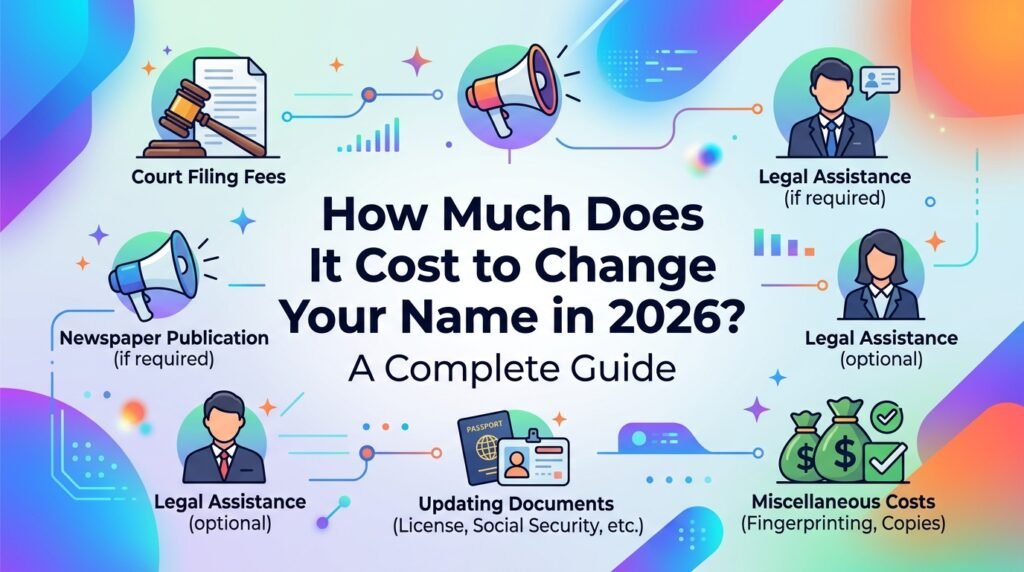
A complete name change has several cost categories. Many people budget only for the first one and are surprised by the rest.
1. Court Filing Fee
This is usually the biggest single expense. For a standard adult petition, filing fees generally run $100 to $500, depending on your state and county. Many states fall in the $150 to $300 range, though some urban courts charge more.
2. Publication Fee
Some states require you to publish a notice of your name change in a local newspaper. This is meant to prevent people from using a name change to dodge debts or legal trouble. Publication typically costs $50 to $200, and in some cities it can climb higher. States like Texas and Florida generally do not require publication, which keeps their totals lower.
3. Background Checks and Fingerprinting
Some courts require a criminal background check to confirm you are not changing your name to hide your history. Expect roughly $20 to $50 for a background check and $30 to $60 for fingerprinting where required.
4. Certified Copies of the Court Order
After the judge approves your petition, you will need certified copies of the order. You will use them for the Social Security office, the DMV, your bank, and more. Each copy usually costs $5 to $25, though some courts charge more. Order several at once, because going back later costs extra time and money.
5. Updating Your Documents
This is the part people forget. Once you have your court order, you need to update your name everywhere. Here is where the money goes.
| Document or Account | Typical Cost |
|---|---|
| Social Security card | Free |
| Driver’s license or state ID | Varies by state, often about $10 – $50 |
| U.S. passport (issued under 1 year) | Free using Form DS-5504 |
| U.S. passport (issued over 1 year ago) | $130 by mail renewal (DS-82) |
| Expedited passport service | Extra $60 |
| Professional licenses (nursing, law, etc.) | Often $25 – $75 each |
Name Change After Marriage
This is the cheapest route for most people. In general, you do not need to file a court petition. Your certified marriage certificate acts as proof of your new name, so you avoid the filing fee, publication, and background checks.
Your main costs are certified copies of the marriage certificate and updated ID documents. Start with the Social Security Administration. Updating your name there costs nothing, and you can find the steps on the official Social Security name change page. After that, update your driver’s license, bank accounts, employer records, and insurance.
Name Change After Divorce
If you want to return to a former name after divorce, the smartest move is to request it inside your divorce decree. When the judge grants it with the divorce, you usually avoid a separate filing fee entirely. If you wait until later, you will likely have to file a standard petition and pay the full court fees.
Changing Your Name by Court Order (For Any Other Reason)
If you want a brand-new first name, a completely different last name, or a change that has nothing to do with marriage or divorce, you will file a petition with your local court. The steps are generally:
- Complete the petition forms.
- Pay the filing fee.
- Complete publication or background checks if required.
- Attend a hearing if your court requires one.
- Receive the signed court order.
- Order certified copies and update your records.
The process can take anywhere from a few weeks to a few months, depending on the court’s schedule.
Changing a Child’s Name
Changing a minor’s name is usually more complicated and more expensive. Courts generally require consent from both parents or guardians, and a judge must decide that the change is in the child’s best interest. If one parent objects, the case can turn into a contested hearing, which may require legal representation and, in some cases, additional evaluations that add significantly to the bill.
If you are choosing a name for your child, take your time. Our guide to unique names with beautiful meanings can help you find one you will love for years to come.
Do You Need a Lawyer?
For a simple adult name change, most people can handle the paperwork on their own. Court clerks provide forms, and many courts have self-help centers. A lawyer becomes worthwhile if your case is complicated, for example, if you have a criminal record, the name change involves a minor with a disputed custody situation, or you simply want someone else to handle everything.
Attorney fees vary widely. Some firms advertise flat-fee packages for a name change petition that can exceed $1,500, while others charge less. Get a quote before you commit.
Name Change Costs Outside the United States
Fees and rules differ widely by country. In the United Kingdom, for example, many people change their name by deed poll, which is a legal document rather than a court case. You can read the official guidance on GOV.UK. Other countries have their own registries, notary systems, or gazette-notification rules, so always check your government’s official website before paying anyone.
Hidden Costs People Often Miss
- Travel timing: If you have a trip coming up, expedited passport service adds cost, and booking tickets under the wrong name can be expensive to fix.
- Time off work: Court hearings and DMV visits may cost you wages.
- Notary and postage fees: Small, but they add up.
- Business and professional updates: Business licenses, domain registrations, and professional memberships may charge their own fees.
- Replacement cards: Bank cards, insurance cards, and membership cards may need reissuing.
How to Save Money on a Name Change
- Ask about a fee waiver. Many courts waive the filing fee if paying would cause financial hardship. Ask the clerk what documents you need to show.
- Include it in your divorce. If you are getting divorced, request the name change in the decree.
- Update your passport within one year. If your passport was issued less than a year ago, Form DS-5504 is free unless you pay for expedited service. See the State Department’s official passport name change page.
- Check publication rules. Some courts allow cheaper publication options or waive publication in special circumstances.
- Order enough certified copies the first time.
- Do it yourself when the case is simple. Court self-help centers are often free.
- Compare nearby counties if your state lets you choose where to file.
Cost vs. Value: Is a Name Change Worth It?
For many people, the money is a small price for something that affects your identity every day. A name that reflects who you are can improve confidence, simplify life after marriage, and bring a sense of closure after a hard chapter. Plan carefully, budget for the extras, and the process stays manageable.
Not sure which name feels right? Explore more ideas on NameEnchant before you file.
Frequently Asked Questions
How much does it cost to legally change your name in 2026?
Most US adults pay between $150 and $800 in total, including the filing fee, publication, certified copies, and document updates. The exact amount depends on your state and county.
Is changing your name after marriage free?
The legal step itself usually does not require a court petition, so you avoid filing fees. You will still pay for certified marriage certificate copies and possibly a new driver’s license or passport.
Is it free to change your name with Social Security?
Yes. The Social Security Administration does not charge a fee to update your name on your card.
How much does it cost to change your name on a passport?
If your passport was issued less than a year ago, a name change using Form DS-5504 is free unless you pay for expedited service. If it is older, you will generally renew using Form DS-82 for $130 for a passport book. Expedited service costs an extra $60. Always confirm current fees on travel.state.gov, since they can change.
Can I get a name change fee waiver?
In many courts, yes. If you can show financial hardship, you can request a waiver of the filing fee. Ask your court clerk for the form.
How long does a name change take?
Anywhere from a few weeks to a few months, depending on court scheduling, hearing requirements, and publication periods.
Do I need a lawyer to change my name?
Not for a straightforward adult petition. A lawyer is more useful for complicated cases, such as contested minor name changes.
Does it cost more to change a child’s name?
Often yes. Court approval and parental consent are required, and disputes can raise costs significantly.
Conclusion
The cost to change your name in 2026 can range from almost nothing, in the case of a simple marriage-related update, to several hundred dollars or more for a court-ordered change. The key is to understand every expense before you begin: the filing fee, publication, certified copies, and the many small updates that follow.
