

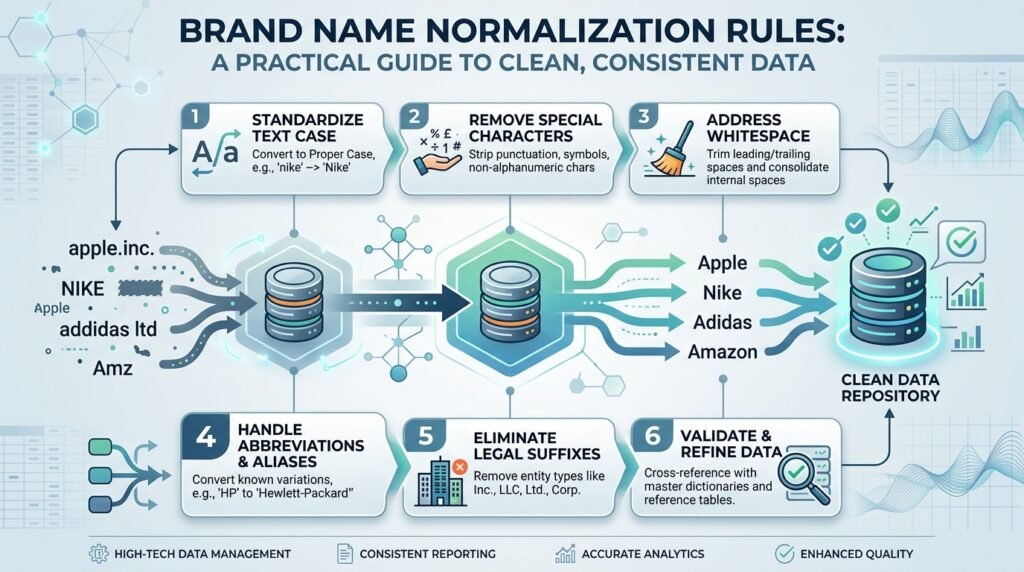
Look at any large product catalog, customer database, or marketing report, and you will usually find the same brand written five different ways. “Procter & Gamble,” “P&G,” “Procter and Gamble Co.,” “PROCTER & GAMBLE,” and “Procter&Gamble” can all sit side by side, each treated as a separate company. The result is messy reports, duplicate records, broken filters, and bad business decisions.
Brand name normalization fixes this problem. It is the process of converting every variation of a brand name into one standard, consistent form. This guide explains the core brand name normalization rules, shows how to apply them step by step, and covers the mistakes that cause most data-quality headaches. If you enjoy exploring how names work and why they matter, you can also browse more naming guides at Name Enchant.
What Is Brand Name Normalization?
Brand name normalization is the practice of applying a fixed set of rules so that every mention of a brand maps to a single canonical (official) name. The canonical name is the version your organization has chosen as the “source of truth,” and every variation is matched back to it.
This is closely related to the broader idea of text normalization, where raw text is transformed into a consistent, predictable form. Brand normalization applies that idea to one specific job: making sure “Nike,” “NIKE Inc.,” and “nike” all resolve to the same entity.
Normalization vs. Standardization vs. Deduplication
These terms are often mixed up, so it helps to separate them.
- Normalization changes the format of a name (case, spacing, punctuation) so variations become comparable.
- Standardization picks the single approved version of the name and enforces it everywhere.
- Deduplication finds and merges duplicate records after names have been cleaned. It is a close cousin of record linkage, the wider field of matching records that refer to the same real-world entity.
In practice, you normalize first, standardize second, and deduplicate last. Skipping the first step makes the other two far less accurate.
Why Brand Name Normalization Matters
Clean brand names are not a cosmetic detail. They affect real outcomes.
Accurate Reporting and Analytics
If sales for one brand are split across four spellings, no report will show its true performance. Normalization consolidates the numbers so that trends, rankings, and market share are correct.
Better Search and Filtering
Shoppers who filter an online store by brand expect one entry per brand. Duplicates like “Levi’s,” “Levis,” and “Levi Strauss” force them to guess, and they often miss products.
Cleaner CRM and Marketing Data
Duplicate company records lead to repeated outreach, conflicting notes, and confused sales teams. Normalized names make it far easier to match accounts and keep one clean record per company. This discipline is a key part of master data management, which aims to keep one trusted version of each core business entity.
Stronger SEO and Product Feeds
Search engines and shopping platforms prefer consistent product data. Uniform brand attributes in your structured data and feeds help products get matched, indexed, and displayed correctly. The schema.org Brand type shows how brands are described in structured markup, and Google’s Search Central documentation stresses clear, consistent product information.
The Core Brand Name Normalization Rules
The rules below form a reliable foundation. Apply them in order, because each step prepares the text for the next.
Rule 1: Trim and Collapse Whitespace
Remove leading and trailing spaces, and replace any run of multiple spaces (including tabs and non-breaking spaces) with a single space. Invisible whitespace is one of the most common reasons two “identical” brand names fail to match.
Example: " Coca-Cola " becomes "Coca-Cola".
Rule 2: Use a Consistent Letter Case
Choose one case convention for matching and one for display.
- For matching: convert everything to lowercase so “ADIDAS,” “Adidas,” and “adidas” compare as equal.
- For display: use the brand’s official styling, such as “adidas,” “eBay,” “iPhone,” or “IKEA.”
Never display the lowercase matching version to customers. It is a behind-the-scenes key only.
Rule 3: Normalize Unicode Characters
Computers can store the same visible character in different ways. The letter “é” can be one character or an “e” plus a combining accent. The Unicode Consortium defines standard forms to solve this in Unicode Standard Annex #15. Converting all text to one form (commonly NFC or NFKC) prevents invisible mismatches.
Also watch for look-alike characters, curly versus straight apostrophes, and en dashes versus hyphens. These differences are invisible to the eye but break exact matching.
Rule 4: Handle Accents and Diacritics Carefully
Brands such as “Nestlé,” “Häagen-Dazs,” and “Citroën” include accents. Two reasonable approaches exist:
- Keep accents in the display name and strip them only in the matching key, so “Nestlé” and “Nestle” both match.
- Keep accents everywhere if your audience and systems fully support them.
Whichever you choose, apply it consistently. Mixing the two is what creates duplicates.
Rule 5: Standardize Punctuation and Symbols
Punctuation causes endless variation. Decide how to treat each of these:
- Ampersands: convert “&” and “and” to one form, so “Johnson & Johnson” matches “Johnson and Johnson.”
- Apostrophes: decide whether “Levi’s” becomes “Levis” in the matching key.
- Hyphens and periods: “Coca-Cola,” “Coca Cola,” and “Coke” need clear rules; “H.P.” and “HP” should resolve together.
- Special symbols: characters such as “®,” “™,” and “©” should be removed from names entirely.
Rule 6: Remove or Standardize Legal Suffixes
Legal entity endings like “Inc.,” “LLC,” “Ltd.,” “GmbH,” “S.A.,” and “Corp.” describe a company’s legal structure, not its brand. Strip them for matching, and store them separately if you need them for contracts or invoices.
Example: “Microsoft Corporation,” “Microsoft Corp.,” and “Microsoft” all resolve to “Microsoft.”
One caution: do not strip suffixes blindly when they are part of the brand identity itself. A name like “Dollar Tree, Inc.” and an unrelated “Tree Inc.” need human review, not automatic trimming.
Rule 7: Expand or Standardize Abbreviations
Decide whether abbreviations stay short or become full names. “IBM” and “International Business Machines” are the same company, but a simple text rule will not connect them. These pairs belong in a mapping table (covered in Rule 9) rather than in general text rules.
Rule 8: Handle Generic Words and Stop Words
Words like “the,” “company,” “group,” and “brands” often add noise. “The North Face” and “North Face” should match. Create a controlled list of removable words, and test it, because some generic words are meaningful in specific brands.
Rule 9: Build an Alias and Synonym Table
Rules alone cannot solve everything. Some variations are not spelling differences but genuinely different names for one brand: nicknames, abbreviations, former names, and regional names. Examples include “Coke” for “Coca-Cola,” “Merc” for “Mercedes-Benz,” or “Facebook” for “Meta” in older data.
Keep a maintained alias table that maps every known variant to its canonical name. This table is the heart of any serious normalization system.
Rule 10: Define a Single Canonical Name
Every brand should have exactly one canonical record that includes:
- The official display name
- The normalized matching key
- A list of known aliases
- An optional unique brand ID
Always reference the brand ID in your databases rather than the free-text name. IDs never contain typos.
Quick Reference Table: Normalization Rules in Action
| Raw Input | Issue | Normalized Output |
|---|---|---|
NIKE | Extra spaces, wrong case | Nike |
Procter and Gamble Co. | “and” vs “&”, legal suffix | Procter & Gamble |
Häagen‑Dazs | Special hyphen, diacritics | Häagen-Dazs |
Levis / Levi's | Apostrophe variation | Levi’s |
The North Face® | Stop word, symbol | The North Face |
Coke | Nickname | Coca-Cola |
Samsung Electronics Co., Ltd. | Legal suffix | Samsung |
A Step-by-Step Normalization Workflow
A reliable process keeps results consistent and auditable.
Step 1: Audit Your Existing Data
Export all current brand values and count how many unique spellings you have. Sort them alphabetically and look for obvious clusters. This shows the scale of the problem and highlights the most common patterns.
Step 2: Create Your Rule Set
Write down your decisions for case, punctuation, diacritics, suffixes, and stop words. A written rule set means every team member and every tool treats names the same way.
Step 3: Apply Automated Cleaning
Run the mechanical rules (whitespace, case, Unicode, symbols) automatically. These produce a clean matching key for every record.
Step 4: Match Against Your Canonical List
Compare each cleaned key against your canonical brands and alias table. Exact matches resolve instantly. For close but not identical matches, use fuzzy matching, which measures how similar two strings are using methods like Levenshtein (edit) distance.
Step 5: Review Uncertain Matches Manually
Automation should never make the final call on uncertain cases. Send low-confidence matches to a person for review, then add confirmed results to the alias table so the system learns.
Step 6: Monitor and Maintain
New brands, mergers, rebrands, and misspellings appear constantly. Schedule regular reviews so the canonical list and alias table never go stale.
Common Brand Name Normalization Mistakes to Avoid
Even experienced teams make these errors.
Over-Normalizing
Aggressive cleaning can merge brands that are genuinely different. Stripping every punctuation mark and generic word might turn two unrelated companies into the same key. Always test rules against real data before applying them at scale.
Ignoring Trademark Differences
Brand names are legally protected, and similar names can belong to different owners in different categories. Normalization is a data-quality tool, not a legal one. For ownership questions, check official registries such as the USPTO trademark database or the WIPO Global Brand Database.
Forgetting Regional and Language Variants
A brand may use different names or scripts in different countries. If you operate internationally, plan for translations, transliterations, and local spellings from the start.
Relying Only on Fuzzy Matching
Fuzzy matching is helpful but imperfect. Names like “Apple” and “Apple Bank” are similar on paper and different in reality. Combine fuzzy logic with alias tables and human review.
Not Documenting the Rules
Undocumented rules live in one person’s head. When that person leaves, consistency leaves with them. Keep a shared, versioned rules document.
Best Practices for Long-Term Consistency
- Store both raw and normalized values. Never overwrite the original input; keep it for auditing.
- Use brand IDs. Link records to IDs, not text strings.
- Validate at entry. Use dropdowns or autocomplete so users pick from approved brands instead of typing freely.
- Assign an owner. One person or team should own the canonical list.
- Test with real samples. Run new rules on a sample before applying them to the whole database.
- Log every change. An audit trail lets you reverse mistakes quickly.
Tools That Can Help
You do not always need to build everything from scratch. Spreadsheet formulas such as TRIM, LOWER, and SUBSTITUTE handle basic cleaning. For larger datasets, Python libraries such as pandas for data cleaning and RapidFuzz for fuzzy matching automate the work, and dedicated data-quality or master data management platforms add matching, workflows, and review queues. Choose a tool that matches your data volume and your team’s skills.
Frequently Asked Questions
What is the difference between a brand name and a company name?
A brand name is how customers know a product or product line, such as “Pampers,” while the company name is the legal owner, such as “Procter & Gamble.” Many companies own many brands, so keep the two fields separate and link them through a parent-brand relationship.
Should I keep brand names in uppercase or lowercase?
Use lowercase (or another single case) for the hidden matching key, and use the brand’s official styling for display. This gives you reliable matching without sacrificing how the brand wants to be presented.
How do I handle a brand that has been renamed or acquired?
Keep the old name as an alias that points to the new canonical name, and record the change date if it matters. This preserves historical data while keeping current reports clean.
Can brand name normalization be fully automated?
Most of it can, especially case, whitespace, Unicode, and punctuation. Ambiguous matches and new brands still need human review, so a hybrid approach works best.
How often should I update my alias table?
Review it at least quarterly, and immediately after major launches, mergers, or imports from new data sources.
Does normalization help SEO?
Yes, indirectly. Consistent brand data improves structured markup, product feeds, internal search, and site navigation, all of which support a better user experience and clearer signals to search engines.
Conclusion
Brand name normalization rules turn chaotic, inconsistent data into a clean and trustworthy foundation. Start by trimming spaces, fixing case, and normalizing Unicode. Then standardize punctuation, handle legal suffixes and stop words, and finish with a strong alias table and one canonical record per brand. Keep the raw data, document every rule, and let humans review the uncertain cases.
