

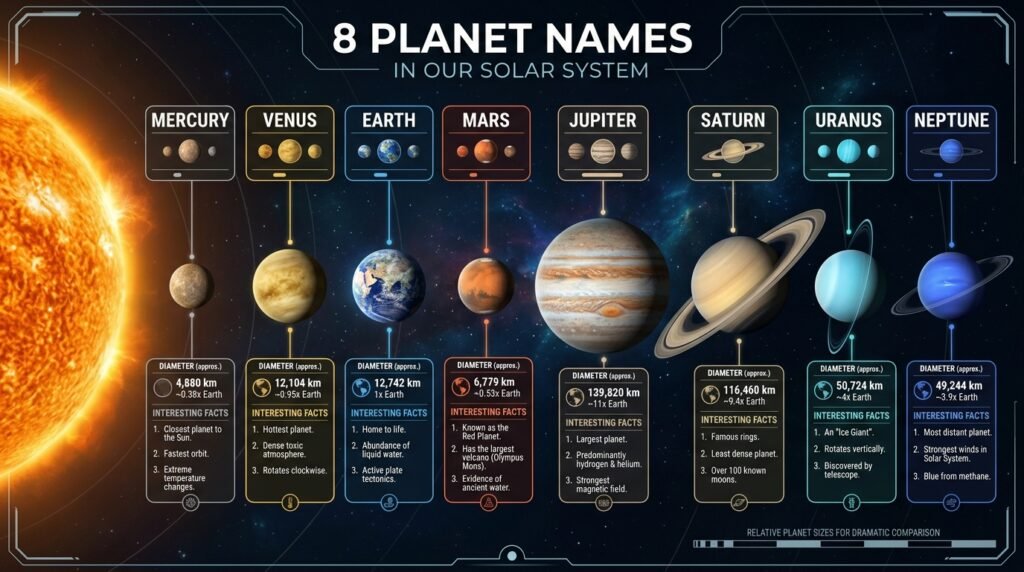
Look up on a clear night, and you may spot a steady, bright “star” that doesn’t twinkle. Chances are, it’s a planet. Our solar system is home to eight of them, each with its own size, personality, and story. Some are scorching, some are freezing, and some are so large that every other planet could fit inside them.
In this guide, you’ll learn the names of all eight planets, their order from the Sun, how big each one is, and a few facts that might surprise you. If you enjoy exploring the meanings and stories behind names, you can also browse more creative naming guides on Name Enchant, including our Moon-Inspired Names and Star-Inspired Names collections.
What Is a Planet?
According to the International Astronomical Union (IAU), an object is a planet if it meets three conditions:
- It orbits the Sun.
- It is massive enough for its own gravity to pull it into a roughly round shape.
- It has cleared its orbit of other large debris.
Pluto fails the third rule, which is why it was reclassified as a dwarf planet in 2006. That leaves us with eight official planets. You can read more on NASA’s solar system exploration pages.
The 8 Planets in Order From the Sun
A handy memory trick is the sentence: “My Very Educated Mother Just Served Us Nachos.” Each first letter matches a planet in order.
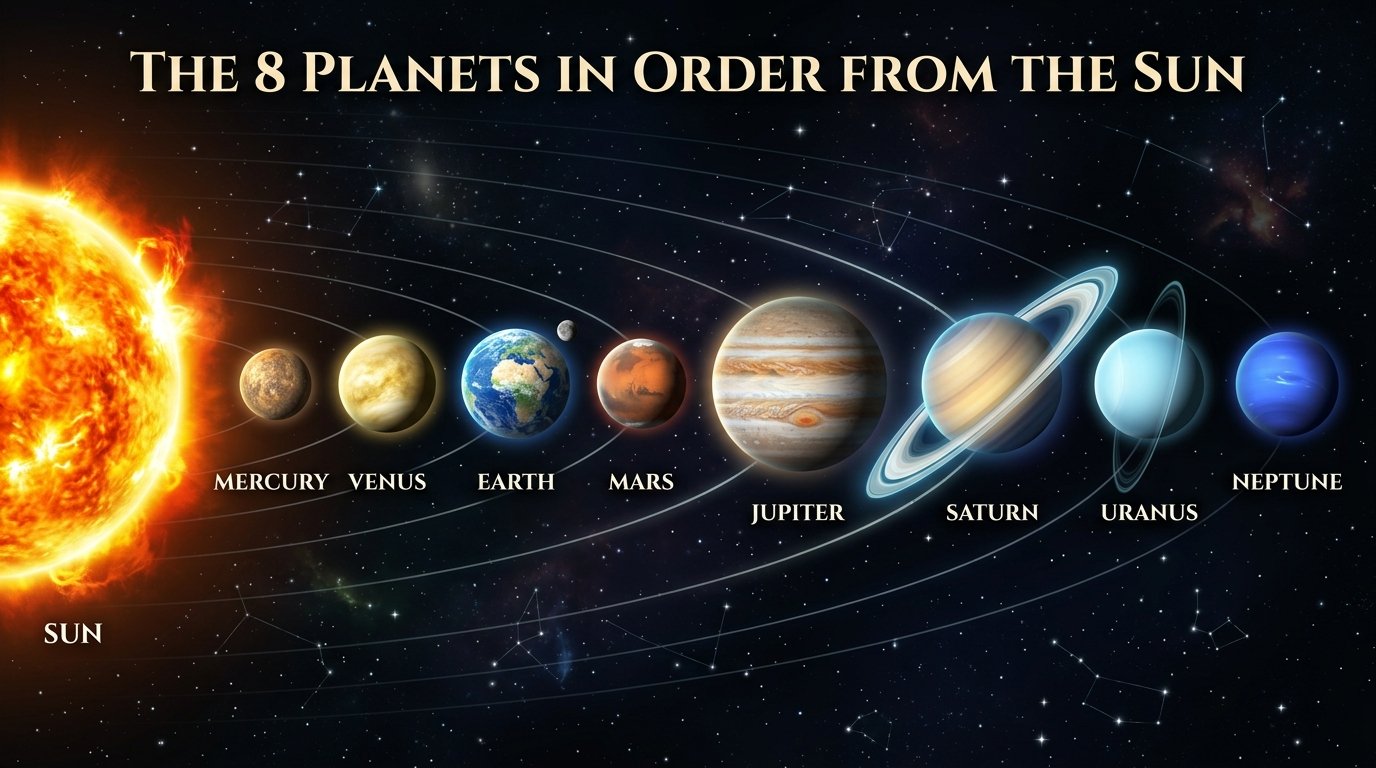
- Mercury
- Venus
- Earth
- Mars
- Jupiter
- Saturn
- Uranus
- Neptune
Scientists split these into two groups. The first four are terrestrial (rocky) planets: small, solid, and close to the Sun. The last four are giant planets: Jupiter and Saturn are gas giants, while Uranus and Neptune are ice giants.
Quick Comparison Table
| Planet | Order | Type | Diameter (approx.) | Distance From Sun (approx.) | Year Length | Known Moons |
|---|---|---|---|---|---|---|
| Mercury | 1st | Rocky | 4,879 km | 58 million km | 88 Earth days | 0 |
| Venus | 2nd | Rocky | 12,104 km | 108 million km | 225 Earth days | 0 |
| Earth | 3rd | Rocky | 12,742 km | 150 million km | 365 days | 1 |
| Mars | 4th | Rocky | 6,779 km | 228 million km | 687 Earth days | 2 |
| Jupiter | 5th | Gas giant | 139,820 km | 778 million km | 11.9 Earth years | 95+ |
| Saturn | 6th | Gas giant | 116,460 km | 1.43 billion km | 29.4 Earth years | 140+ |
| Uranus | 7th | Ice giant | 50,724 km | 2.87 billion km | 84 Earth years | 28 |
| Neptune | 8th | Ice giant | 49,244 km | 4.5 billion km | 165 Earth years | 16 |
Moon counts keep changing as astronomers discover new ones, so treat these as approximate.
1. Mercury: The Smallest and Swiftest Planet
Mercury is the closest planet to the Sun and the smallest in our solar system, only slightly larger than Earth’s Moon. It’s named after the Roman messenger god, which fits, because it races around the Sun in just 88 days.
Interesting Facts About Mercury
- Despite being closest to the Sun, it isn’t the hottest planet. With almost no atmosphere to trap heat, daytime temperatures reach about 430°C, while nights plunge to around -180°C.
- One day on Mercury (sunrise to sunrise) lasts about 176 Earth days, which is twice as long as its year.
- Its surface is covered in craters, much like our Moon.
2. Venus: The Hottest Planet
Venus is almost the same size as Earth, which is why it’s often called our “sister planet.” But the similarities end there. Its thick atmosphere of carbon dioxide traps heat in a runaway greenhouse effect, pushing surface temperatures to about 465°C, hot enough to melt lead.
Interesting Facts About Venus
- Venus spins backward compared with most planets, so the Sun rises in the west.
- A day on Venus (one full rotation) takes about 243 Earth days, longer than its 225-day year.
- It’s the brightest planet in our night sky, often called the “Morning Star” or “Evening Star.”
3. Earth: Our Home Planet
Earth is the only place we know of that supports life. About 71% of its surface is covered in water, and its atmosphere shields us from harmful radiation while keeping temperatures comfortable.
Interesting Facts About Earth
- Earth is the densest planet in the solar system.
- Its single Moon stabilizes the tilt of Earth’s axis, which helps keep our seasons steady.
- It’s the only planet not named after a Greek or Roman god. The word comes from Old English and Germanic words meaning “ground.”
For more details, see NASA’s Earth overview.
4. Mars: The Red Planet
Mars gets its rusty color from iron oxide (essentially rust) in its soil. It’s cold, dry, and dusty, but evidence shows that rivers and lakes once flowed across its surface billions of years ago, which is why scientists keep sending rovers there.
Interesting Facts About Mars
- Olympus Mons, a volcano on Mars, stands roughly 22 km high, about two and a half times the height of Mount Everest.
- Mars has two small, potato-shaped moons: Phobos and Deimos.
- A day on Mars is just over 24 hours, close to Earth’s.
5. Jupiter: The King of the Planets
Jupiter is the largest planet in our solar system. It’s so massive that more than 1,300 Earths could fit inside it. Named after the king of the Roman gods, it’s a swirling ball of hydrogen and helium with no solid surface.
Interesting Facts About Jupiter
- The Great Red Spot is a giant storm that has been raging for centuries and is wider than Earth.
- Jupiter has the shortest day of all the planets, spinning once in under 10 hours.
- Its moon Ganymede is the largest in the solar system, even bigger than Mercury.
6. Saturn: The Ringed Beauty
Saturn is famous for its spectacular ring system, made of billions of pieces of ice and rock, ranging from tiny grains to boulders. It’s the second-largest planet and the least dense of all. In theory, it would float in a bathtub big enough to hold it.
Interesting Facts About Saturn
- Its rings stretch hundreds of thousands of kilometers across but are often only about 10 meters thick in places.
- Saturn has well over 140 known moons, including Titan, which has a thick atmosphere and lakes of liquid methane.
- The planet has a strange hexagon-shaped storm at its north pole.
7. Uranus: The Sideways Planet
Uranus is an ice giant made mostly of water, ammonia, and methane ices surrounding a small rocky core. Methane in its atmosphere absorbs red light, giving the planet its pale blue-green color.
Interesting Facts About Uranus
- It rotates on its side, tilted about 98 degrees, so it seems to roll around the Sun like a ball.
- Each pole gets about 42 years of continuous sunlight followed by 42 years of darkness.
- It was the first planet discovered with a telescope, by William Herschel in 1781.
- Its moons are named after characters from Shakespeare and Alexander Pope, such as Titania, Oberon, and Miranda.
8. Neptune: The Windy Blue Giant
Neptune is the farthest planet from the Sun and was found through mathematical predictions before anyone saw it through a telescope. Its deep blue color comes from methane in its atmosphere.
Interesting Facts About Neptune
- Neptune has the fastest winds in the solar system, reaching about 2,000 km/h.
- One Neptunian year equals roughly 165 Earth years. It completed its first orbit since discovery in 2011.
- Its largest moon, Triton, orbits backward and is likely a captured object from the Kuiper Belt.
Planet Sizes Compared: From Smallest to Largest
If we line up the planets by diameter, the order looks like this:
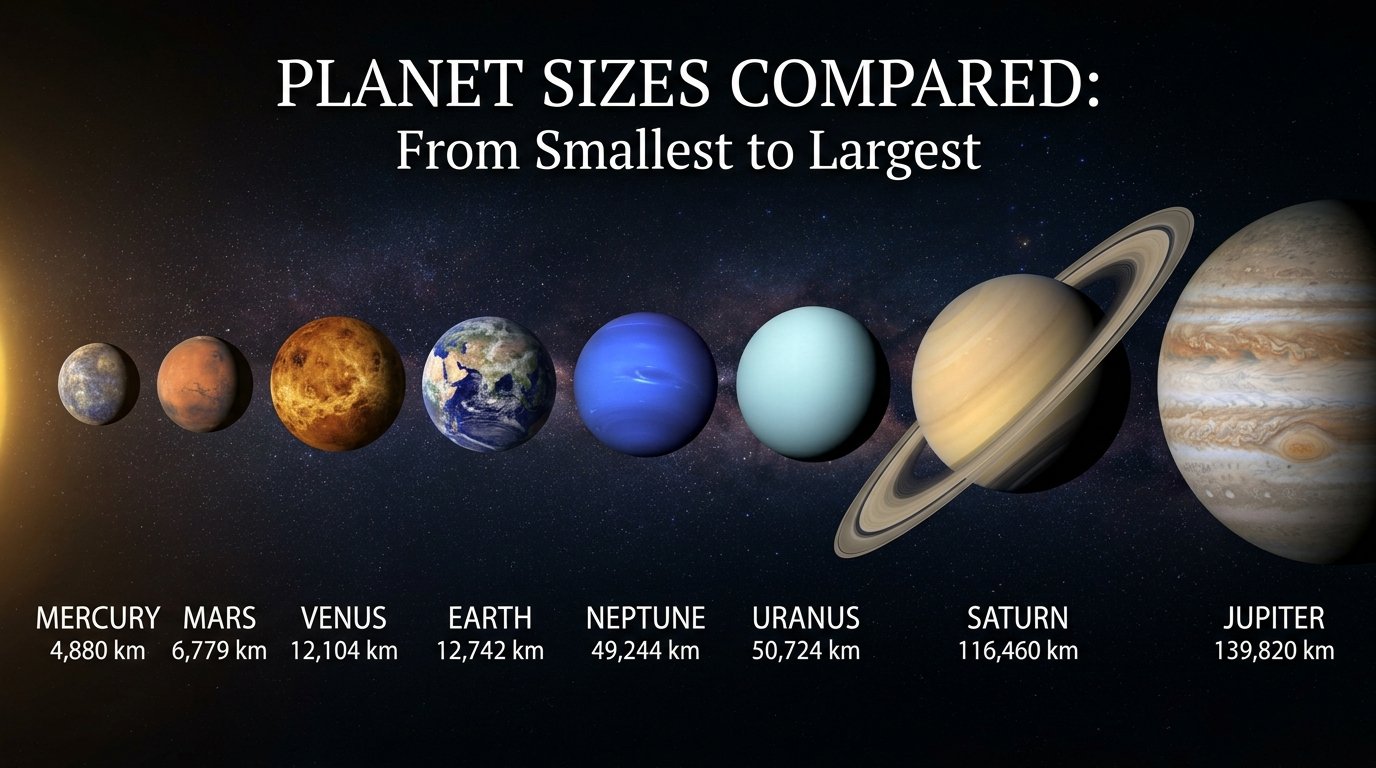
- Mercury
- Mars
- Venus
- Earth
- Neptune
- Uranus
- Saturn
- Jupiter
Notice that Venus and Earth are nearly twins in size, as are Uranus and Neptune. Jupiter, meanwhile, is more than 11 times wider than Earth.
Why Are the Planets Named After Roman Gods?
Mercury, Venus, Mars, Jupiter, and Saturn have been visible to the naked eye since ancient times. Early civilizations, especially the Greeks and Romans, linked them to gods and legends. Uranus and Neptune were discovered much later, but astronomers kept the tradition going by choosing names from classical mythology. This blend of science and storytelling is a reminder of how names carry meaning. If you love that idea, explore more name origins and meanings at Name Enchant.
Frequently Asked Questions
How many planets are in our solar system?
There are eight: Mercury, Venus, Earth, Mars, Jupiter, Saturn, Uranus, and Neptune.
Which planet is the largest?
Jupiter is the largest planet, with a diameter of about 139,820 km.
Which planet is the smallest?
Mercury is the smallest planet in our solar system.
Which planet is the hottest?
Venus is the hottest planet, with surface temperatures near 465°C, thanks to its dense, heat-trapping atmosphere.
Why isn’t Pluto a planet anymore?
In 2006, the IAU defined what a planet is. Pluto doesn’t clear its orbit of other objects, so it’s now classified as a dwarf planet.
Which planets have rings?
All four giant planets (Jupiter, Saturn, Uranus, and Neptune) have rings, but Saturn’s are by far the most visible.
Can any planet other than Earth support life?
So far, no other planet is known to host life. Scientists are studying Mars and the moons of Jupiter and Saturn for signs of past or present microbial life.
Conclusion
From tiny, fast Mercury to distant, windy Neptune, the eight planets of our solar system show just how varied worlds can be. Remember the order with the “My Very Educated Mother Just Served Us Nachos” trick, and you’ll never forget who comes where. The more we explore, the more we realize that every planet, like every name, has a story worth telling.
Namescategory
