

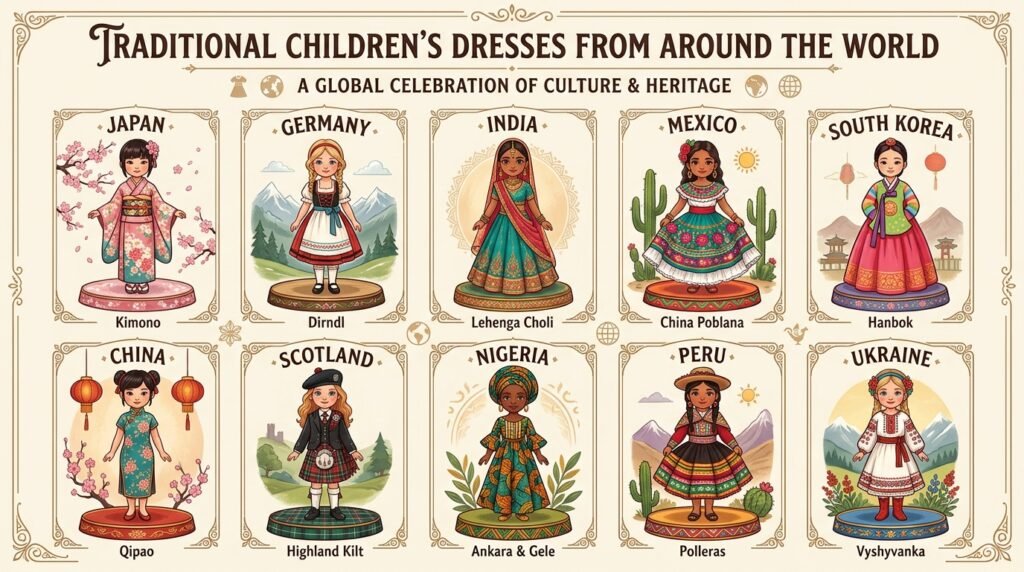
Every culture dresses its youngest members with care. A child’s festival outfit is rarely just clothing. It is a small, colorful piece of history that carries a family’s stories, a region’s craftsmanship, and a community’s values. From silk robes in Tokyo to woolen shawls in the Peruvian Andes, traditional kids’ dresses show how the world celebrates childhood.
In this guide, you will meet ten traditional kids’ dresses from around the world. For each one, you will learn where it comes from, what it looks like, when children wear it,t and what makes it special. Whether you are a parent planning a cultural day at school, a teacher building a lesson, a costume designer, or simply a curious reader, these outfits are a wonderful way to explore global heritage.
Let’s begin the journey.
1. Kimono (Japan)
The kimono is Japan’s best-known traditional garment, and its name literally means “thing to wear.” Children’s kimonos are cut as T-shaped, straight-line robes that wrap left over right and are tied with a sash called an obi. Girls’ versions often feature cranes, cherry blossoms, ms or ball-shaped temari patterns, while boys’ kimonos lean toward deeper tones such as navy, black,k and grey. Boys may also wear a hakama, a pleated trouser that looks like a skirt, with a haori jacket. Because children grow quickly, kimonos are made with deep tucks at the shoulders and waist, so the garment can be adjusted over several years.
When Kids Wear It
The most famous occasion is Shichi-Go-San (“Seven-Five-Three”), held around November 15. Children aged three, five, and seven visit a shrine to give thanks for their healthy growth and to pray for the future. Lighter cotton versions called yukata appear at summer fireworks and festivals.
2. Hanbok (Korea)
The hanbok is the traditional dress of Korea, admired for its graceful lines and vivid colors. A girl’s hanbok usually includes a short jacket called a jeogori and a full, high-waisted skirt called a chima. A boy’s outfit combines the jeogori with loose trousers known as baji, often topped with a vest and a small hat. Children’s hanbok sometimes feature saekdong, rainbow-striped sleeves that are said to bring good fortune and keep bad luck away.
When Kids Wear It
Babies wear a special hanbok for their dol, the first birthday party, a milestone celebrated for centuries. Families also dress children in hanbok for Seollal (Lunar New Year) and Chuseok, the autumn harvest holiday, when younger family members bow to their elders.
3. Lehenga Choli (India)
The lehenga choli is a three-piece outfit popular across India, especially in the northern and western regions. It combines a fitted blouse (choli), a long flared skirt (lehenga), and a scarf-like dupatta. Kids’ versions are lighter than bridal ones and use soft cotton, silk blends,s or brocade, decorated with mirror work, zari thread, gota trim,im or hand embroidery. Boys typically wear a kurta-pajama, which is a long tunic with fitted trousers, or a more formal sherwani with a contrasting stole.
When Kids Wear It
Children wear these outfits for Diwali, weddings, Raksha Bandhan, and school functions. During Navratri in Gujarat, girls and boys dress in bright, mirror-studded chaniya cholis and kediyu tops to dance the garba and dandiya.
4. Shalwar Kameez (Pakistan)
The shalwar kameez is the national dress of Pakistan and is worn by people of every age. The kameez is a long tunic, and the shalwar is a pair of loose, gathered trousers that taper at the ankle. Girls often add a dupatta. Boys’ sets are commonly finished with a waistcoat and, for special days, a sherwani-style coat. Fabrics change with the season: breathable cotton and lawn for summer, and wool or khaddar for winter. Festive sets add embroidery, sequins, or delicate lace.
When Kids Wear It
Children wear brand-new shalwar kameez on Eid morning, a tradition many families treasure, as well as at weddings and on Independence Day, August 14. Regional styles add variety, from Sindhi ajrak patterns to the embroidery of Balochistan.
5. Kilt (Scotland)
The kilt is the proud symbol of Scotland. It is a knee-length, pleated wrap garment made from woolen tartan, a woven checked pattern linked to particular clans and districts. Children’s kilts are often adjustable, with straps and buckles that let them grow with the child. A full outfit may include a sporran (a small pouch worn at the waist), knee-high kilt hose, ghillie brogues and a fitted jacket. Girls may wear a tartan skirt or a tartan sash draped over a white dress.
When Kids Wear It
Kids wear kilts at weddings, ceilidhs (traditional social dances), Highland dancing competitions, and on Burns Night, held every January 25. Many families choose a tartan connected to their surname or heritage, which turns the outfit into a personal keepsake.
6. Dirndl and Lederhosen (Germany and Austria)
These two outfits come from the Alpine regions of southern Germany and Austria, where they began as practical working clothes before becoming proud festive wear. A dirndl features a fitted bodice, a white blouse, a gathered skirt and an apron. Lederhosen are knee-length leather shorts worn with suspenders, a checked shirt, wool socks, and sometimes a felt hat decorated with a feather. Children’s versions are made in soft leather or cotton and cheerful colors, so kids can play comfortably.
When Kids Wear It
Families dress up for Oktoberfest in Munich, which has family days that welcome little ones, as well as for spring festivals, church celebrations and village parades. Tracht, the German word for traditional dress, often becomes a family tradition passed from older siblings to younger ones.
7. Bunad (Norway)
The bunad is Norway’s national costume, and every region has its own version. Girls’ bunads typically include a long wool skirt, an embroidered bodice, a white blouse, and a decorated apron, completed by silver jewelry called sølje. Boys’ versions feature a wool jacket, vest,t and knee-length trousers. Colors and embroidery patterns depend on the area, so one look at a bunad often tells you where a family comes from. Child-sized versions, called barnebunad, are made to be altered or handed down.
When Kids Wear It
May 17, Constitution Day, is the biggest day for the bunad. Children join colorful parades through towns and cities, waving flags and eating ice cream. Bunads also appear at christenings, confirmations, and weddings.
8. Folklórico and Charro Outfits (Mexico)
Mexican children’s traditional clothing blends Indigenous and Spanish influences. Girls often wear a wide, ruffled skirt trimmed with ribbons and paired with an embroidered or lace blouse, designed to fan out beautifully when they spin. Boys may wear a traje de charro, inspired by Mexican horsemen, with a short jacket, fitted trousers decorated with buttons, and a wide-brimmed sombrero. Designs differ by state, from the ribbon skirts of Jalisco to the floral embroidery of Oaxaca.
When Kids Wear It
Children wear these outfits for Independence Day on September 16, school folklórico dance performances, and family celebrations such as baptisms. The Jarabe Tapatío, often called the Mexican hat dance, is a favorite performance piece.
9. Andean Dress (Peru)
In the Andes, Quechua communities have dressed their children in handwoven alpaca and sheep’s wool for generations. Girls wear a pollera, a layered skirt, with an embroidered blouse, a woven shawl called a manta, and often a brimmed hat called a montera. Boys wear a poncho, woven trousers, and the iconic chullo, a knitted hat with earflaps that keeps heads warm at high altitude. Bright reds, pinks and greens come from natural dyes, and bold geometric patterns often represent mountains, rivers and animals.
When Kids Wear It
Children wear these outfits at festivals such as Inti Raymi in Cusco on June 24, at village dance competitions, and in school parades. Weaving remains a living craft, with many skills still passed from parents to children.
10. Kente Cloth Outfits (Ghana)
Kente is a hand-woven cloth from the Ashanti and Ewe peoples of Ghana, made of narrow, colorful strips stitched together. Each color and pattern carries meaning. Gold is often linked to wealth and royalty, green to growth and renewal, and blue to peace and harmony. Boys’ outfits may include a cloth wrapped over the shoulder, while girls wear dresses, headwraps, or skirt-and-top sets. Smaller pieces are often worn as sashes or stoles over everyday clothes.
When Kids Wear It
Kente appears at naming ceremonies, traditional festivals, school graduations, and Independence Day on March 6. Because it was once reserved for royalty, it carries a deep sense of pride, and families treasure it.
Quick Comparison of Traditional Kids’ Dresses
| Dress | Country | Key Pieces | Popular Occasions |
|---|---|---|---|
| Kimono | Japan | Robe, obi, hakama | Shichi-Go-San, summer festivals |
| Hanbok | Korea | Jeogori, chima, baji | Dol, Seollal, Chuseok |
| Lehenga Choli | India | Choli, lehenga, dupatta | Diwali, weddings, Navratri |
| Shalwar Kameez | Pakistan | Kameez, shalwar, waistcoat | Eid, weddings, Independence Day |
| Kilt | Scotland | Tartan kilt, sporran, hose | Ceilidhs, Burns Night, weddings |
| Dirndl and Lederhosen | Germany and Austria | Bodice, apron, leather shorts | Oktoberfest, village festivals |
| Bunad | Norway | Wool skirt or trousers, jewelry | Constitution Day, confirmations |
| Folklórico and Charro | Mexico | Ribbon skirt, charro suit | Independence Day, dance shows |
| Andean Dress | Peru | Pollera, poncho, chullo | Inti Raymi, village festivals |
| Kente Outfits | Ghana | Woven cloth, sashes | Naming ceremonies, graduations |
Tips for Choosing and Caring for Traditional Kids’ Outfits
Prioritize Comfort and Fit
Children move, spin, and sit on the floor, so choose outfits with soft linings, adjustable waists, and room to grow. Avoid heavy embellishment on areas that touch the skin, and test the outfit at home before the big day.
Pay Attention to Fabric and Care
Natural fabrics such as cotton, silk,k and wool breathe well, but they may need gentle handling. Check the label before washing, hand-wash embroidered pieces, and store garments folded in a cool, dry place. Delicate items can be wrapped in cotton cloth to protect the threads.
Respect the Culture
Learn what an outfit means before wearing it. Many garments are tied to religious or ceremonial occasions, so it helps to share the story with children and, when possible, buy from artisans or communities that make them. This turns dressing up into an act of respect and learning.
Frequently Asked Questions
What is the most colorful traditional dress for kids?
Many people point to Indian lehenga cholis, Mexican folklórico skirts, and Ghanaian kente because of their bold color combinations. Korean hanbok with rainbow sleeves is also a strong contender.
Can kids wear traditional dresses every day?
In some places, yes. The shalwar kameez is everyday wear across South Asia, for example. Others, like the kimono or bunad, are mostly saved for festivals and special occasions.
How do I teach children about traditional clothing?
Pair the clothing with stories, music and food from the same culture. Let children touch the fabrics, learn a few words in the local language, and look at photographs of celebrations.
Are traditional kids’ dresses suitable for school cultural days?
Absolutely. They are a great way to celebrate diversity. Choose comfortable versions and explain the origin of the outfit so classmates can learn from it.
Where can I buy authentic traditional children’s clothing?
Look for local artisans, cultural markets, family-run boutiques, and trusted online stores that credit their makers. Authentic pieces often include handwoven fabric or hand embroidery.
Conclusion
Traditional kids’ dresses are far more than costumes. A kimono tied with an obi, a kilt in a family tartan, or a kente sash worn at a naming ceremony each tells a story about identity, belonging, and joy. These ten outfits show how many different ways there are to celebrate childhood, and how much beauty lives in each culture’s craftsmanship.
